
99,00 €
inkl. MwSt.
zzgl. Versandkosten
In den Warenkorb
Foreword
The Nature of Desire in the Tension Between Cultures
The modern Western world looks at erotica primarily through the lens of sociology and psychology. Thinkers such as Erich Fromm exhorted the art of loving, while Eva Illouz analyses the ‘cold intimacy’ of our commodity world. Yet while the West loses itself in reflection on fears of commitment and the limits of language – very much in the sense of Wittgenstein – one space often remains strangely empty: the immediate, nature-given essence of the human being.
In ancient Indian literature, as Richard Schmidt opened it up in 1901 in his monumental ‘Con- tributions to Indian Erotics’ (Beiträge zur Indischen Erotik), we encounter an entirely different cosmos. Brahmanic scholarship (the ‘Sanskrit people’) did not regard desire as a psychological problem, but as part of the doctrine of nature (Naturlehre). The classification of lovers according to animal species such as hare, bull, or stallion is far more than a metaphor. It is the recognition of a specific, anatomical, and temperamental resonance – a search for harmony through categorisation within nature.
However, today’s Indian reality, which I have been able to observe over 25 years of travelling in India, paints a different picture. Particularly in the cities and across all social classes, a deep confusion is palpable. The millennia-old Vedic tradition clashes unfiltered with Western ideas of erotica and love. Since the advent of the Internet and global access to pornographic depictions, this process has accelerated. A blending has emerged that often leads to great helplessness in dealing with the opposite sex – an alienation that, in its intensity, apparently even surpasses that in the West.
This observation of vanishing orientation provided the impetus for the present book. Based on Schmidt’s collection of sources, I wish to direct the gaze back to the archaic wisdom of the „Sanskrit people“. Not as a nostalgic retreat, but as a mirror for a present that has lost its own instinctive language in the static of globalised images. Perhaps the key to a genuine connection lies not in the adoption of foreign ideals, but in the rediscovery of that nature-given signature which ancient India knew how to read so precisely.
In order to make the depth and the strangeness of the Vedic perspectives graspable for the Western mind, I repeatedly employ significant voices from our Western cultural history as a mirror in this work. Thinkers such as Erich Fromm, Alfred Adler, or Ovid, but also medical and psychological pioneers such as Galen, Giambattista della Porta, and Sigmund Freud serve me as bridgebuilders. Even the Western evolution of erotica in the 20th century, as embodied for instance by Beate Uhse with the practical liberation and commercialisation of desire, or the extensive contributions of Eva Illouz, form a necessary counterweight to the Indian tradition. This interdisciplinary dialogue is intended to show where our cultures touch, where they differ diametrically, and why we today – in a time of global digital alienation – need these old signposts more urgently than ever.
In his translation of the Sanskrit texts, Richard Schmidt often translated only into Latin, especially in the last 300 pages. In doing so, he did not use Latin for poetic enrichment, but as a defensive wall. This practice was widespread among scholars in the late 19th and early 20th centuries. It was called the ‘language of the learned’ to protect the ‘common people’ or ‘immature readers’ from explicit content. Thus, Schmidt used ‘Latinisation’ as censorship: he did indeed translat the Kāmasūtra, but as soon as the Sanskrit became anatomically or sexually very explicit, he fled into Latin. This means that ‘educated readers’ (the clerics and scientists) were allowed to read of pleasure, while it was withheld from the ordinary citizen. In my edition, these barriers have now been torn down and the texts are presented in their original, factual directness. Thus, the veil of artificial scholarship is lifted, which for over a century obstructed the view of Vatsyayana’s precise powers of observation.
For regardless of which religion or culture has shaped us, we all carry within us the same animal heritage of our genesis – written into our genes.
Goethe recognised in the ‘West-Eastern Divan’ (West-östlicher Divan) that universal signature which connects human beings across geographical borders:
‘He who knows himself and others,
Will also here recognise:
Orient and Occident
Are no longer to be parted.’ (1)
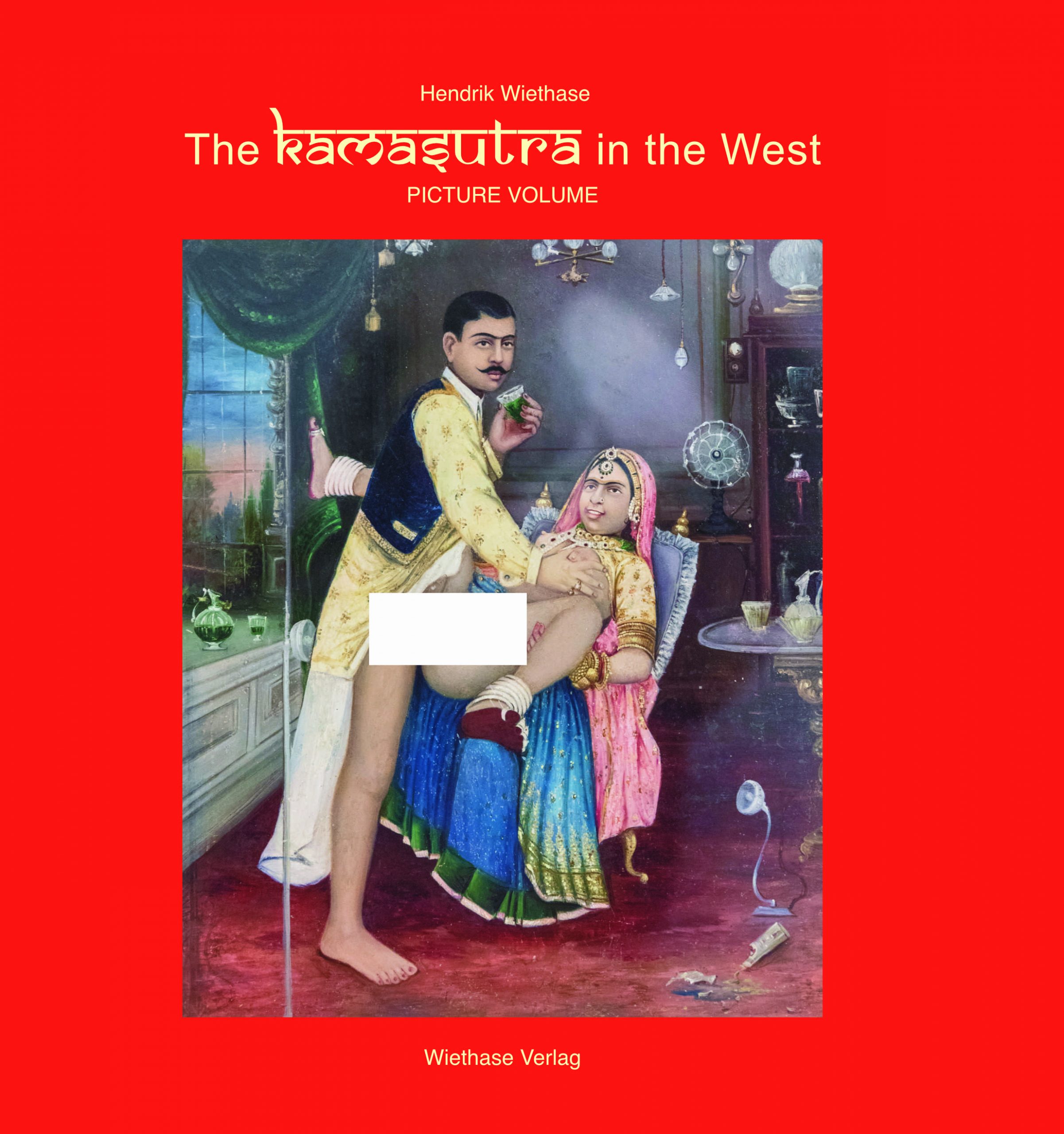
Together, the two volumes comprise 660 pages. They will be published exclusively as a limited and numbered edition of 50 copies for € 99..